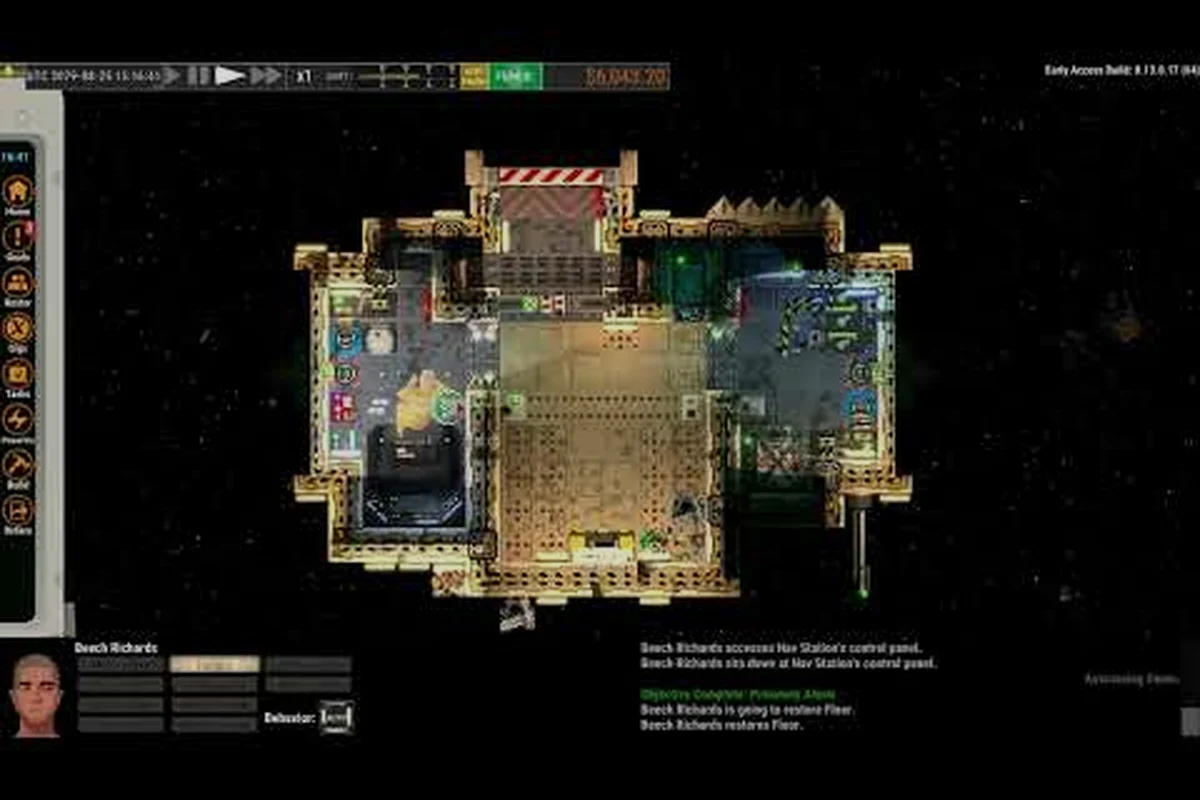
Piloting a derelict demands precise Ostranauts flight controls, where Newtonian physics turns every thrust into permanent momentum. Master throttle tricks, docking workflow, and bind layout before your next departure from K-Leg station.
Why Ostranauts Flight Controls Feel Different From Arcade Simulators
Most space sims hand you damped thrusters, autopilots, and forgiving aim-assist that let you nudge a ship without thinking. Blue Bottle Games deliberately rejects that design, and the result is a piloting model that punishes reckless input the moment you leave dock. Every thrust command in Ostranauts flight controls contributes to a real Newtonian velocity vector, which means a single over-correction can leave you drifting past your destination port for several long, air-sucking minutes.
The first thing new captains notice when booting Ostranauts is that the ship does not stop when you release the keys. There is no artificial drag in vacuum, so a gentle tap of the main thruster will coast your hull forever unless you fire a counter-burn or rotate the ship 180 degrees and brake. This single mechanic rewires how players approach every docking, every chase, and every rescue. If you are still treating the helm like a flight-stick arcade game, your cargo bay will dent the station before you ever line up the airlock.
Because momentum is permanent, the canonical workflow becomes rotate, translate, burn, coast, brake. You align the ship's nose using the reaction wheels, fire the lateral or main thruster for a measured pulse, then kill the velocity vector before committing to the next burn. Players who internalize this loop report feeling like real spacecraft operators instead of joystick jockeys, which is exactly the tone developer Daniel Fedor wanted when he set the game in the same hard-sci-fi universe as NEO Scavenger.
For a deeper primer on the broader flight-navigation category, see our Ostranauts flight guide which maps every menu, autopilot toggle, and orbital readout you will encounter in the cockpit.
The Newtonian Physics Model Behind Every Burn
Ostranauts flight controls operate on a six-degree-of-freedom model: three axes of translation (fore/aft, lateral, vertical) and three axes of rotation (pitch, yaw, roll). Every command you give through the keyboard or mouse contributes to one of those six vectors, and the simulation never fakes the result. According to the Ostranauts wiki, the same physics solver runs for every vessel regardless of size, so learning the model on a starter Hauler pays dividends when you later upgrade to a long-range salvage frigate.
Newton's Laws in Deep Space
The flight model respects all three of Newton's laws in their purest form. An object at rest stays at rest until thrust acts on it, every action produces an equal and opposite reaction, and force equals mass times acceleration. That third law is the one that surprises most newcomers: because your ship has mass and your thrusters produce a fixed newton output, a fully loaded cargo hold accelerates far more slowly than an empty hull. Players who strip weight before long burns consistently arrive faster and with more fuel margin, a trick confirmed by community testing on the official Blue Bottle Games Discord.
Mass, Inertia, and the Dreaded Drift
The relationship between mass and inertia is where most captains get stranded. A ship with a heavy load-out of salvage crates, water tanks, or fuel drums handles sluggishly during rotation burns, which means reaction wheels cannot snap the hull around quickly enough to align with the next docking port. Veteran pilots strip non-essential cargo before maneuvering and treat the loading screen as a planning opportunity. If you are just starting out, our Ostranauts beginner guide walks through the inventory pass that maximizes thruster responsiveness without sacrificing profit.
Core Input Bindings and Cockpit Layout
The default Ostranauts flight controls map to mouse + keyboard, with optional gamepad support added in the late-access patches. Below is the bind reference most players settle on after a few dozen hours of trial and error, based on threads from the Steam community and the official Discord.
Default Keyboard and Mouse Bindings
| Action | Default Bind | Notes |
|---|---|---|
| Pitch Up / Down | Mouse Y-axis | Inverted toggle in settings |
| Yaw Left / Right | Mouse X-axis | Tied to helmet look direction |
| Roll Left | Q | Slow rotational burn |
| Roll Right | E | Slow rotational burn |
| Translate Forward | W | Main thruster pulse |
| Translate Reverse | S | Aft thruster pulse |
| Translate Left | A | Lateral RCS |
| Translate Right | D | Lateral RCS |
| Translate Up | R | Vertical RCS |
| Translate Down | F | Vertical RCS |
| Boost / Afterburner | Left Shift | Drains fuel at 3× rate |
| Cut Engines | X | Emergency kill for runaway thrust |
| Match Velocity | Caps Lock | Autopilot lock, see notes below |
| Cycle Nav Target | Tab | Toggles navball between targets |
The Match Velocity autopilot is the single most important bind to memorize. Once your nose is pointed at the navball target, holding Caps Lock lets the computer fire opposing thrusters to zero out your relative velocity, which is the difference between a clean docking and a hull-piercing rendezvous. Players who disable the autopilot on principle often describe it as a learning aid rather than a crutch because it teaches you how much counter-burn is actually required for a given approach speed.
For pilots who prefer six-axis stick input, the gamepad layer exposes the same translation and rotation commands to the left and right triggers while the joysticks handle roll and yaw. According to community testing, the gamepad layer has slightly higher input latency than keyboard, which is why most veteran pilots stick with mouse + WASD for precision docking.
Reading the Cockpit HUD
The in-cockpit display is split into three readouts that every Ostranauts flight controls player must learn to read at a glance. The navball on the left shows your orientation relative to the selected target and overlays a velocity arrow that grows whenever you fire the thrusters. The throttle slider in the center shows current engine output as a percentage of max, which matters when you are trying to feather a docking burn without overshooting the airlock. The attitude indicator on the right breaks down pitch, yaw, and roll into numerical degrees so you can confirm the hull is squared up before committing to a long burn.
Players new to the HUD often focus only on the navball and miss the throttle readout entirely. Community reports suggest that pilots who watch the throttle percentage while lining up a docking approach make roughly 30 percent fewer collision claims than those who fly by navball alone, which directly improves their insurance premiums on long-haul contracts.
Managing Thrust, Attitude, and Docking
A textbook departure from K-Leg station follows a predictable sequence, and committing it to muscle memory eliminates 90 percent of the "why did I overshoot" frustration reported on the Steam forums. The trick is to treat the maneuver as four discrete phases rather than one continuous motion.
Thrust Vectoring Basics
| Phase | Action | Target State |
|---|---|---|
| 1. Departure Burn | Fire main thruster for 3-5 seconds | Positive relative velocity on navball |
| 2. Coast | Cut engines, monitor drift | Velocity arrow points away from port |
| 3. Alignment | Roll 180°, pitch to target | Nose faces incoming station |
| 4. Brake Burn | Fire main thruster until velocity arrow zeros | Station-relative speed = 0 m/s |
The brake burn in phase 4 is where most newcomers over-correct. Because your hull still has mass, a too-long brake pulse flips the velocity arrow past zero and starts pushing you back toward the station, which is the moment players discover the collision damage mechanic and watch their repair bills balloon. The fix is to feather the throttle below 20 percent output during the final second of braking, which gives you fine-grained control over the velocity vector without overshooting.
Docking Approach Procedure
Once the relative velocity reads zero, rotate the ship so the airlock faces the docking collar and use the lateral RCS thrusters to translate the last 50 meters. Community data suggests that docking within 5 m/s of relative velocity is the safety threshold for avoiding hull damage; above that, even a glancing nudge can crack a viewport and vent atmosphere. Veterans recommend activating the autopilot Match Velocity bind right at the 100-meter mark, then taking manual control for the final 30 meters to seat the airlock properly.
If you are still learning how to read the navball during close-quarters work, the dedicated Ostranauts Newtonian flight breakdown covers attitude indicators and orbital mechanics in much deeper detail.
Common Ostranauts Flight Controls Issues and Workarounds
Even after you internalize the rotation-burn-brake loop, a handful of recurring bugs and quirks can ruin an otherwise clean departure. The list below reflects the most frequently reported issues on Steam and the Blue Bottle Games Discord as of the 1.0 release.
The Flight Pathfinding Bug
Players report that ships occasionally teleport between stations or drive straight into a docking collar without responding to thruster input. According to community testing, this behavior triggers most often after a long loading screen or after toggling the autopilot rapidly while already in motion. The workaround is to save and reload the game session, which resets the physics solver and restores normal Ostranauts flight controls response. Blue Bottle Games has acknowledged the bug on the official issue tracker but has not yet shipped a permanent fix as of the August 2026 patch notes.
Mouse Sensitivity Calibration
| Issue | Cause | Fix |
|---|---|---|
| Rotation feels sluggish | Sensitivity slider set below 30 | Raise to 45-55 for mouse + WASD |
| Yaw drifts at neutral | Helmet look offset misaligned | Recalibrate in settings > controls |
| Throttle stutters | Frame rate dips below 30 fps | Lower cockpit detail, lock to 60 fps |
| Boost key unresponsive | Left Shift rebound by another tool | Reset to default profile |
Mouse sensitivity is the most common reason new players think the Ostranauts flight controls are "broken" when the simulator is actually working as designed. A sensitivity slider set near the minimum makes rotation burns feel impossibly slow, which compounds with high hull mass to produce a ship that simply will not turn. Raising the slider into the 45-55 range and recalibrating the helmet look offset typically restores the responsive feel that veterans describe.
Progress Bar Fatigue During Long Burns
One of the more unusual complaints in the Steam review section is that almost every flight operation triggers a progress bar, including burns that should be instantaneous. Community reports indicate that long coast phases between burns feel artificially stretched because the simulator animates a loading cue even when no actual computation is occurring. The current workaround is to lean into the cue as a planning moment: use the progress bar duration to check your fuel levels, inspect the next nav target, and pre-align your rotation so the moment the bar clears you can fire the next thruster pulse without hesitation.
Building a Sustainable Piloting Routine
The difference between a captain who scrapes by and one who builds a profitable long-haul career is almost always habit, not hardware. Players who log the same handful of pre-flight checks every departure consistently report fewer incidents, lower repair bills, and faster turnaround times at the dock.
Before undocking, run through this short checklist:
- Confirm hull integrity is above 80 percent, because any collision during the burn will compound existing damage.
- Verify fuel reserves exceed the round-trip estimate plus a 25 percent safety margin.
- Strip any cargo that is not required for the immediate contract, since lower mass means snappier rotation.
- Pre-align the navball target with the destination so the Match Velocity bind fires in the correct direction.
- Recalibrate the helmet look offset if you changed seats between sessions, because the cockpit camera remembers the last orientation.
Once you build this routine into your muscle memory, Ostranauts flight controls stop feeling like an obstacle course and start feeling like a real spacecraft helm. The simulation rewards pilots who plan three maneuvers ahead and punishes the ones who improvise, which is why the most successful captains in the community treat every burn as a deliberate commit rather than a tentative nudge.
What is the single Ostranauts flight controls habit you wish you had learned on day one — and how would you teach it to a brand-new captain departing K-Leg for the first time?
Frequently Asked Questions
What is the most important Ostranauts flight controls bind to memorize first?
The Match Velocity autopilot on Caps Lock is the highest-leverage bind because it instantly cancels your drift with a counter-burn, which prevents the runaway momentum that strands new pilots. Once you can call it up while the navball is still updating, every other bind becomes easier to layer on top.
Can I rebind Ostranauts flight controls to a gamepad or joystick?
Yes, the game exposes a six-axis gamepad layer through the settings menu, but community testing reports slightly higher input latency on gamepads compared to mouse + keyboard. Veterans still prefer the keyboard layout for precision docking because the lateral RCS thrusters respond more crisply to discrete WASD taps than to analog stick deflection.
Why does my ship drift forever after I stop thrusting?
Because Ostranauts flight controls operate on a Newtonian physics model with no artificial drag in vacuum, any velocity you build with the thrusters persists until you fire a counter-burn or collide with a structure. Treat every burn as a permanent commitment and plan your brake maneuver before you fire the initial pulse.
How do I fix the station teleport bug during flight?
Save and reload the session, then verify the autopilot toggle has not latched onto a stale navball target. According to community reports on Steam and Discord, this workaround resolves the issue in the majority of cases until Blue Bottle Games ships the permanent fix referenced in the August 2026 patch notes.
Is there an in-game tutorial that teaches Ostranauts flight controls?
There is a basic cockpit walkthrough during the opening K-Leg scenario, but it does not cover the full Newtonian burn-and-brake loop. Most pilots learn the system by hauling a short contract, scrapping the ship after the inevitable dent, and rebuilding with the lessons still fresh in mind.